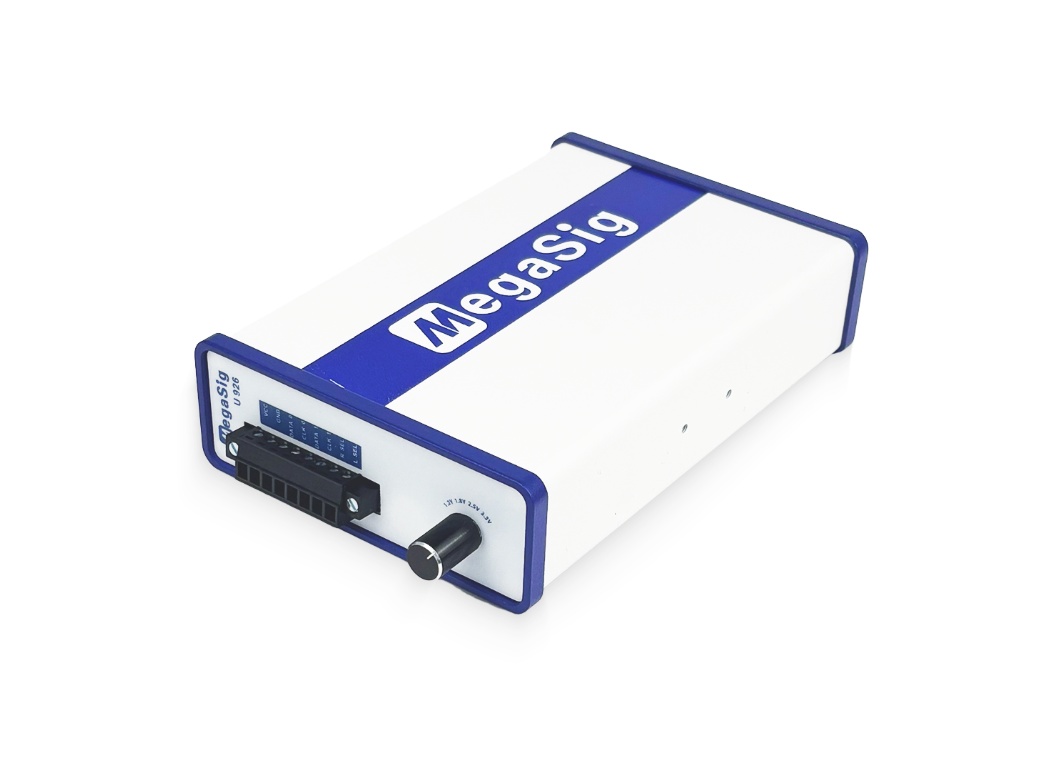
I. Overview
The MegaSig U 926 is a 4-channel PDM to Digital Signal Conditioner designed for production lines and R&D . In modern digital voice and vibration measurement, sensors are increasingly shifting from analog output to direct PDM (Pulse Density Modulation) digital signals. The U 926 can perfectly receive and demodulate these high-speed 1-bit digital streams, making it a precision core device specifically built for production line testing of PDM MEMS microphones and PDM MEMS accelerometers .
II. Technical Background and Challenges of PDM Measurement
Before delving into the details of the device, we must first clarify why PDM sensors require a dedicated test conditioner.
Unlike traditional PCM (Pulse Code Modulation), which directly records the specific amplitude value of each sample point, PDM is a ” 1-bit oversampled ” digital encoding technique. It samples analog signals at extremely high frequencies (usually in the range of several MHz) and characterizes the amplitude of the original signal through the “density” of the output pulses.
This architecture offers significant advantages in hardware engineering: it requires only two transmission lines, clock and data , to operate and boasts strong anti-interference capabilities. Furthermore, PDM supports stereo mode, allowing two microphones to share a single data line, outputting signals on the rising and falling edges of the clock signal respectively.
However, this also presents challenges for the testing end: the analysis instrument must be able to provide the sensor with the accurate clock and stable DC power supply required, and have powerful desampling filtering capabilities to convert the PDM bit stream of several MHz into the standard PCM format in order to further perform audio algorithm analysis such as frequency response or distortion (THD).
III. Core Technology and Specification Advantages of MegaSig U 926
To address the pain points of PDM sensor test integration, the U 926 offers a highly integrated solution with the following core technological highlights:
1. Flexible and Highly Compatible Hardware Power Supply and Clock Settings:
MEMS microphones and accelerometers on the market have varying requirements for operating voltage and clock speed. The U926 offers great flexibility in hardware settings, supporting four adjustable voltage levels (Vcc): 1.2V, 1.8V, 2.5V, and 3.3V . For clock output, it supports a wide adjustment range from 0.256 MHz to 6.144 MHz . Furthermore, for complex array testing, the U926’s dual PDM channel clock can be set to synchronous or asynchronous output, fully meeting the timing specifications of various chipsets.
2. Built-in High-Order Downsampling and Data Transfer Engine:
The U 926 features four PDM signal acquisition channels and utilizes USB bus and DMA (Direct Memory Access) for high-speed data transfer. The system incorporates a standard x64 downsampling factor , perfectly aligned with industry-leading PDM microphone decoding ratios (e.g., downsampling a 3.072 MHz clock speed by 64 times to convert it to a standard 48 kHz audio sampling rate), and supports a converted sampling rate range from 4K to 96K.
3. Lab-Grade Exceptional Distortion Specifications:
When evaluating microphone distortion, the conditioner must not become a bottleneck in the system. The U 926 demonstrates exceptional signal resolution: at fs=48kS/s and an input signal of 1kHz sine wave (-10dBFS), its typical total harmonic distortion (THD) is as low as -124.7 dBFS , while the typical total harmonic distortion plus noise (THD+N) reaches -103.5 dBFS . Even at a high sampling rate of fs=96kS/s, THD+N remains at an excellent level of -99.3 dBFS, ensuring accurate capture of background noise and subtle imperfections from high-end sensors.
4. Designed specifically for production line automation:
The U 926 features a compact and robust design, measuring only 96 × 33 × 140 mm . It operates in temperatures ranging from -20°C to 50°C, making it ideal for deployment in space-constrained automated enclosures or production line cabinets. For production line cycle control, the device also supports 5V rising edge external triggering , enabling precise synchronization with PLC fixture pressing actions for zero-delay automated measurement.
IV. Typical Application Scenarios
Based on the above superior specifications, the MegaSig U 926 is the preferred choice for the following engineering scenarios:
- Microphone array testing for TWS earphones and smart home devices: Smart speakers and noise-canceling earphones often incorporate multiple PDM digital microphones. The U 926’s 4-channel design can simultaneously read signals from multiple sensors, quickly detecting array consistency, sensitivity, and signal-to-noise ratio (SNR).
- Quality inspection of PDM digital accelerometers: For miniature vibration sensors that directly output PDM digital signals, stable clock drive and low-distortion demodulation are provided to verify the sensor’s frequency response and dynamic range.
V. Summary
The MegaSig U 926 is a dedicated testing device designed to solve the measurement challenges of “1-bit oversampled audio”.
It not only integrates adjustable power supply, wide-band adjustable clock, and high-precision downsampling engine, but also eliminates noise interference in the test system at the hardware level with an extremely low THD performance of -124.7 dBFS. For R&D and production line teams committed to improving the shipment quality of digital electroacoustic components and MEMS sensors, the adoption of U 926 will greatly simplify the test architecture of PDM signals and accelerate the verification cycle of new products, making it an indispensable digital acoustic test infrastructure.