I. Overview
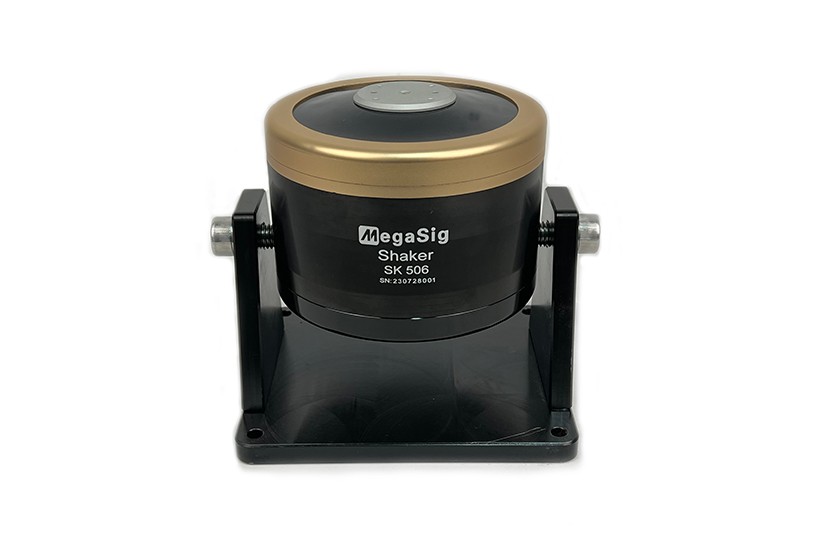
The MegaSig SK 506 is an electromagnetic vibration table/shaker designed specifically for small-scale vibration testing. It was originally designed to meet the environmental vibration simulation and fatigue testing needs of small to medium-sized parts.
In a complete vibration testing system, it acts as an “actuator” that converts electrical signals into precise mechanical vibrations. In the development and production testing of bone conduction technologies (such as noise reduction and sound pickup in TWS earphones and bone conduction headphones), the SK 506 serves as a “standard vibration source,” simulating the weak vibration signals of the skull or jawbone during human speech.
The SK 506’s greatest feature is its compact size (weighing only 8.1 kg) yet powerful performance, providing stable excitation force without the need for an external forced cooling system, making it ideal for space-constrained laboratories or production line integration.
II. Core Functions and Technological Advantages
The SK 506 is optimized for high signal-to-noise ratio and wide bandwidth in its engineering specifications.
1. Silent fanless design (NVH Friendly & High SNR)
- Technical Features: It adopts an optimized magnetic circuit structure and heat dissipation design, and can operate stably at rated power without external forced air cooling .
- Engineering Advantages: This is crucial for bone conduction testing. Bone conduction microphones typically need to pick up weak vibration signals, and the fan noise of traditional exciters can interfere with the sensor through air coupling. The SK 506’s zero-fan noise characteristic ensures an extremely high signal-to-noise ratio (SNR), keeping the testing environment acoustically pure and accurately reproducing minute bone conduction signals.
2. Excellent dynamic performance and vocal frequency coverage
- Frequency Coverage: Supports a frequency range of 20 Hz to 8 kHz . Fully covers the main energy frequency bands of human speech (100Hz-4kHz), accurately simulating the fundamental frequency and overtones of human voice, and verifying the sensor’s response characteristics in key frequency bands.
- Thrust and Acceleration: Rated sinusoidal/random thrust up to 50 N (Peak) , with a maximum acceleration of 20 g . This provides sufficient dynamic headroom to handle both weak simulated human voice vibrations (e.g., 0.1 g) and high-intensity component endurance tests.
3. Ingenious and easily integrated mechanism design
- Compact Size: Weighing only 8.1 kg and measuring Φ138 × 172 mm, it is easily integrated into shielding boxes or automated testing equipment (ATE) on production lines.
- Standard Interface: The output end adopts an M5 threaded stinger, which is convenient for connecting various impedance heads or bone conduction test fixtures.
III. Usage Scenarios
Based on its characteristics of “quiet operation, wide bandwidth, and high precision”, SK 506 is mainly used in the following high-precision fields:
1. Bone Conduction Sensor and TWS Earphone Testing: This is the most competitive application scenario for the SK 506.
- Standard Vibration Source Simulation: As a “simulated human skeleton”, the SK 506 receives signals from the audio analyzer and generates precise mechanical vibrations to drive the test object (such as bone conduction microphones, VPU units of TWS earphones).
- Key Performance Indicator Verification: used to measure frequency response curve , sensitivity consistency , and total harmonic distortion (THD) .
- Algorithm Validation: In the development of call noise reduction (ENC), the SK 506 was used to play a clean bone conduction signal, and ambient noise was played in conjunction with an external speaker to verify the speech activity detection (VAD) and noise suppression capabilities of the DSP algorithm.
2. Environmental Stress Screening (ESS) for Electronic Components
- Perform vibration durability testing on MEMS microphones, sensors, or small connectors. The SK 506 can perform sinusoidal sweeps or random vibrations to eliminate defective products that fail prematurely.
3. Modal Analysis of Small Structures
- As an excitation source for modal testing, it utilizes its 8kHz wide bandwidth and is connected to a slender push rod to accurately excite the natural frequencies and mode shapes of small structures (such as PCB boards and drone arms).
IV. Specifications
| Overall parameters | |
| Rated output (peak) sine/random | 50N |
| Maximum amplitude | ±7.5mm |
| Maximum acceleration | 20g |
| Maximum input current | ≤6Arms |
| Frequency range | 20Hz – 8kHz |
| First-order resonant frequency | 50Hz |
| Moving-coil DC resistor | 0.7 ohm |
| Force constant (N/A) | 7.2 |
| Mass of movable parts | 0.25kg |
| External dimensions (mm) | Φ138*172 |
| Mounting hole dimensions (mm) | 152*128/4-Φ8 |
| Weight | 8.1kg |
| Output method | Stinger |
| Connection method | M5 |
| Elastic support stiffness (N/mm) | 3 |
| Forced air cooling | none |
| Nonlinear | ≤3% (for maximum excitation force) |
| Operating temperature | -30 – +70℃ |
V. Conclusion
The MegaSig SK 506 is not just a general-purpose exciter; it is a powerful tool for cross-disciplinary testing of electroacoustics and vibration.
If you are developing TWS earphones, AR glasses, or military communication devices with bone conduction technology , or need a small, quiet, and precise vibrator that can be placed on a lab bench, the SK 506 is one of the few cost-effective options on the market that can simultaneously meet the requirements of “zero noise interference” and “wideband voice simulation”.
If you require further planning consultation for your project, please feel free to contact us for technical exchange.