I. Overview
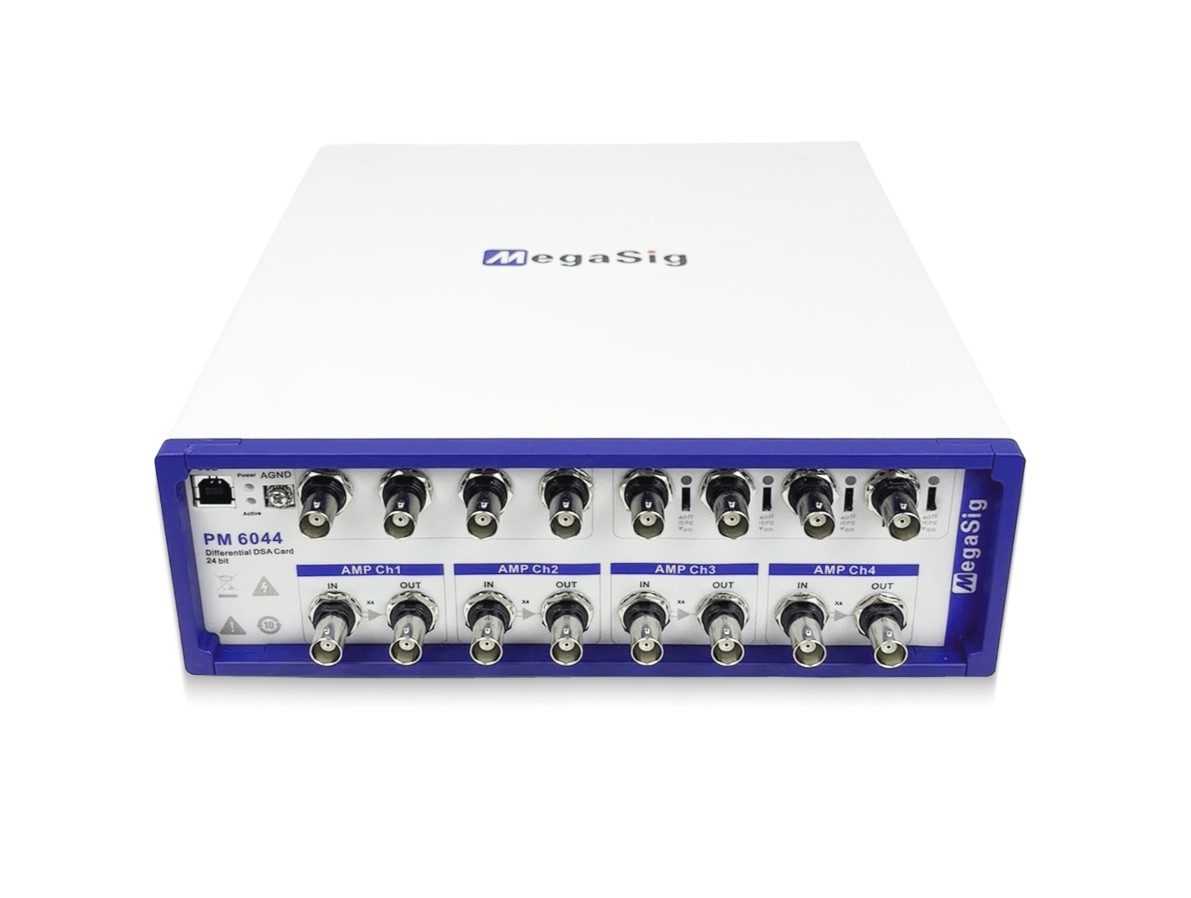
The PM 6044 is an integrated audio analyzer with 4 IEPE inputs and 4 16W outputs per channel. The input voltage range is +/- 4.5Vrms, and the output voltage range is +/- 3.5Vrms . This device supports WDM (WASAPI) drivers and can be operated directly under the Windows system interface , compatible with standard recording software such as Audacity .
If you need to use your own in-house developed testing software for mass production testing , or if you require higher output channels to drive multiple loads, then the PM 6044 is a highly cost-effective option in our product line. Below, we will provide a detailed explanation from both technical function and application scenarios, combining specifications and market experience.
II. Core Functions and Technological Advantages of the Product
The PM 6044 is designed to balance input and output and maximize power amplifier density to achieve extremely high test integration.
1. Balanced 4-input, 4-output architecture (4 Audio Input Channels / 4 Audio Output Channels)
- Input: Features 4 analog input channels supporting differential signal input. Each channel has a built-in IEPE constant current source excitation (providing 24V power), which can be enabled or disabled via software. This means you can directly connect and drive microphones, artificial ears, or accelerometers without external signal processing equipment.
- Output: The PM 6044 provides four analog output channels , which provides a foundation for multi-station testing.
2. High-density power amplification integration (Built-in 4-Ch Amplifier)
- The compact chassis integrates four independent power amplification channels , with a single channel power of up to 16W .
- Flexible switching: The output channel can be selected as direct line output or connected to the internal power amplifier baseboard to directly drive high-power loads such as speaker units or artificial mouthpieces.
3. Excellent performance
- Despite being positioned for mass production testing, its specifications still reach the level of a high-precision analyzer. It employs a 24-bit Δ−Σ ADC/DAC and supports sampling rates from 44.1kHz to 192kHz.
- Acquisition performance (AI @ 48kS/s): Signal-to-noise ratio (SNR) typically up to 104 dB , total harmonic distortion plus noise (THD+N) of -94 dB .
- Output performance (AO @ 48kS/s): Signal-to-noise ratio (SNR) typically up to 102 dB , THD+N is -88 dB .
4. Industrial-grade communication and interfaces
- It employs USB bus and DMA transfer mode to ensure real-time performance of multi-channel data streams.
- The entire unit uses a BNC interface, which is suitable for frequent plugging and unplugging in the factory environment; the input voltage range is +/- 4.5Vrms, and it has good overload resistance.
III. Typical Use Cases
With its hardware configuration of “4-channel acquisition + 4-channel power amplifier”, the PM 6044 is particularly suitable for the following applications:
1. High-efficiency parallel testing on the production line.
- One-to-four testing system: This is the core application scenario for the PM 6044. Utilizing its four independent power amplifier outputs and acquisition channels, engineers can build an automated system to simultaneously test four devices under test (such as Bluetooth speakers or speaker units).
- Benefits: Compared to traditional single-channel equipment, it can significantly increase the UPH (output per hour) of the production line, while saving space and equipment costs for the testing cabinet.
2. QC for mass production of electroacoustic components
- Speaker/Receiver Testing: The built-in 16W power amplifier directly drives the individual units, performing rapid scanning tests on frequency response curves, distortion, and impedance curves.
- Microphone/PCBA Testing: The artificial mouth is driven to produce sound through the AO channel, and the microphone signal is collected by the AI channel to verify the consistency of the product.
3. Verification of in-vehicle and multi-channel audio systems
- Simultaneous generation of multiple signals: For scenarios that require simultaneous verification of multiple channels (such as the left/right/front/rear channels of a car audio system), the PM 6044’s 4-channel synchronous output capability provides excellent convenience.
- Vibration and noise detection: Combined with an accelerometer connected via an IEPE interface, it can be used to detect vibration modes and abnormal noises in home appliances or vehicle equipment during operation.
IV. Specifications
| Overall parameters | |
| Analog acquisition channels | 4 |
| Analog output channels | 4 |
| IEPE channels | 4 channels (built into the data acquisition front end) |
| IEPE power supply | 24V |
| Power amplifier channels | 4 |
| Power amplifier output power | 16W (per channel) |
| Bus | USB |
| Product dimensions (mm) | 240*240*76 (L*W*H) |
| Interface type | BNC |
| Operating temperature | -20 – 50℃ |
Input channel parameters
| AI Channel Parameters | |
| ADC accuracy | 24 Bit |
| ADC type | Δ-Σ |
| Sampling rate | 44.1k, 48k, 88.2k, 96k, 192kHz |
| FIFO buffer size | 1024 |
| Data transmission methods | DMA |
| Input voltage range | +/- 4.5Vrms |
| Input impedance | Between the positive input terminal and ground: 1Mohm |
| Flatness | 20Hz – 20kHz, less than +/- 0.15dB, AI -3dB bandwidth: 3Hz-72kHz |
| AI Idle noise (uVrms) | |||
| Sampling rate | fs=48kS/s | fs=96kS/s | fs=192kS/s |
| Typical value | 20 | 23 | 460 |
| Note: [1] Short-circuit source impedance less than 50Ω, operating temperature 23±5℃, IEPE OFF | |||
| AI Signal-to-Noise Ratio (SNR) (dB) | |||
| Sampling rate | fs=48kS/s | fs=96kS/s | fs=192kS/s |
| Typical value | 104 | 102 | 78 |
| Note: [1] Differential input, AC coupling, input signal 1kHz sine wave, 0dBFS (4.5Vrms) [2] Nyquist bandwidth [3] Linear weighting | |||
| AI Dynamic range (dB) | |||
| Sampling rate | fs=48kS/s | fs=96kS/s | fs=192kS/s |
| Typical value | 99 | 99 | 99 |
| Note: [1] Differential input, AC coupling, input signal 1kHz sine wave, -1dBFS (4.01Vrms) [2] Nyquist bandwidth [3] Linear weighting | |||
| AI Total Harmonic Distortion (THD) + Noise (dB) | |||
| Sampling rate | fs=48kS/s | fs=96kS/s | fs=192kS/s |
| Typical value | -94 | -94 | -77 |
| Note: [1] Differential input, AC coupling, input signal 1kHz sine wave, -1dBFS (4.01Vrms) [2] Nyquist bandwidth [3] Linear weighting | |||
| Total Harmonic Distortion (THD) in AI (dB) | |||
| Sampling rate | fs=48kS/s | fs=96kS/s | fs=192kS/s |
| Typical value | -95 | -95 | -97 |
| Note: [1] Differential input, AC coupling, input signal 1kHz sine wave, -1dBFS (4.01Vrms) [2] Nyquist bandwidth [3] linear weighting | |||
| AI Crosstalk (dB) | |||
| Sampling rate | fs=48kS/s | fs=96kS/s | fs=192kS/s |
| Typical value | -104 | -104 | -78 |
| Note: [1] Differential input, AC coupling, input signal 1kHz sine wave, -1dBFS (4.01Vrms), short-circuit source at no signal end less than 50 ohms [2] Nyquist bandwidth [3] Linear weighting | |||
Output channel parameters
| AO channel parameters | |
| DAC accuracy | 24 Bit |
| Sampling rate | 44.1kHz – 192kHz |
| Output voltage range | +/- 3.5Vrms |
| Gain error | +/- 0.03dB |
| Output impedance | Positive input to negative input: 1 ohm |
| Flatness | 20Hz – 20kHz, less than +/- 0.08dB; AO – 3dB bandwidth: 4Hz-75kHz |
| AO Idle noise (uVrms) | |||
| Sampling rate | fs=48kS/s | fs=96kS/s | fs=192kS/s |
| Typical value | 24 | 24 | 80 |
| Note: [1] The impedance of the acquisition device is greater than 1 Mohm, and the operating temperature is 23±5℃. | |||
| AO Signal-to-Noise Ratio (SNR) (dB) | |||
| Sampling rate | fs=48kS/s | fs=96kS/s | fs=192kS/s |
| Typical value | 102 | 102 | 92 |
| Note: [1] Differential output, AC coupling, input signal 1kHz sine wave, 0dBFS (3.5Vrms) [2] Nyquist bandwidth [3] Linear weighting | |||
| AO Dynamic range (dB) | |||
| Sampling rate | fs=48kS/s | fs=96kS/s | fs=192kS/s |
| Typical value | 90 | 90 | 89 |
| Note: [1] Differential output, AC coupling, input signal 1kHz sine wave, -1dBFS (3.11Vrms) [2] Nyquist bandwidth [3] Linear weighting | |||
| AO Total Harmonic Distortion (THD) + Noise (dB) | |||
| Sampling rate | fs=48kS/s | fs=96kS/s | fs=192kS/s |
| Typical value | -88 | -88 | -88 |
| Note: [1] Differential output, AC coupling, input signal 1kHz sine wave, -1dBFS (3.11Vrms) [2] Nyquist bandwidth [3] Linear weighting | |||
| Total Harmonic Distortion (THD) (dB) | |||
| Sampling rate | fs=48kS/s | fs=96kS/s | fs=192kS/s |
| Typical value | -86 | -86 | -86 |
| Note: [1] Differential output, AC coupling, input signal 1kHz sine wave, -1dBFS (3.11Vrms) [2] Nyquist bandwidth [3] Linear weighting | |||
| AO Crosstalk (dB) | |||
| Sampling rate | fs=48kS/s | fs=96kS/s | fs=192kS/s |
| Typical value | -103 | -103 | -93 |
| Note: [1] Differential output, AC coupling, input signal 1kHz sine wave, -1dBFS (3.11Vrms) [2] Nyquist bandwidth [3] Linear weighting | |||