Foreword
In vibration testing of consumer electronics and micro motors, obtaining “real and distortion-free” vibration data has always been a major challenge for production lines and R&D teams.
To address the measurement challenges of micro-mechanisms, the following section introduces the operating principle of the piezoelectric accelerometer and explains why miniaturized sensors must be used in specific testing scenarios .
I. The core of vibration measurement: What is a piezoelectric accelerometer?
In industrial and electroacoustic testing, piezoelectric accelerometers are the most mainstream and reliable sensors for capturing dynamic vibrations.
Its core principle is based on the use of internal sensitive elements such as “piezoelectric ceramic” or quartz. When the sensor is subjected to vibration acceleration, the internal mass will exert an inertial force on the piezoelectric material, causing the piezoelectric material to generate an electric charge signal proportional to the acceleration.
In modern production lines and automated testing, we most commonly use piezoelectric accelerometers based on the IEPE (Integrated Electronics Piezo-Electric) architecture. Traditional charge-type accelerometers have extremely high output impedance, are highly susceptible to electromagnetic interference from the environment, and generate triboelectric noise from any cable movement. They also require expensive external charge amplifiers.
IEPE sensors like the MegaSig ACC 1824 integrate miniature charge amplifier circuitry directly into the sensor housing. This technology offers significant engineering advantages:
- Low impedance output: Signals can be transmitted over long distances directly through standard coaxial cables (such as BNC connectors) without causing high-frequency signal attenuation or deterioration of the signal-to-noise ratio.
- Strong anti-interference capability: IEPE sensors maintain extremely high stability in humid, dirty, or noisy factory environments.
- Plug and play: Voltage signals can be read directly by providing a constant current source (usually 4mA) through a data acquisition card (DAQ), which greatly reduces the training costs for production line operators.
II. Overcoming Physical Interference: The Benefits and Applications of Miniature Accelerometers
For large machine tools or automotive chassis, using standard-sized accelerometers (typically weighing tens to hundreds of grams) is not a problem. However, when the volume and mass of our test object (DUT) are very small, standard accelerometers can cause serious measurement errors. This is why we must introduce miniature accelerometers.
Miniature accelerators have the following irreplaceable advantages and applications in engineering:
- Eliminating the “mass loading effect”: This is the most important physical significance of miniature accelerometers. When a sensor is attached to the object under test (DUT), the sensor’s own weight forms a new mass system with the DUT. If the sensor is too heavy, it will directly change the DUT’s natural resonant frequency and reduce its vibration amplitude. By minimizing the accelerometer’s mass, we can reduce this mass interference to a minimum, thereby ensuring that the measured data is the “true” vibration response of the DUT and maximizing data accuracy.
- Extremely high-frequency response: Due to the extremely small internal structure and mass of the miniature accelerometer, its rigidity is relatively high, which allows for a significant increase in the sensor’s mounting resonant frequency. This high resonant frequency means it can measure extremely high-frequency vibration details and has a lower noise floor.
- Space-Restricted Installations: In today’s highly miniaturized consumer electronics, engineers often need to install sensors in extremely confined spaces (such as the internal circuit board of a mobile phone or the narrow gaps in a wearable device) for drop testing or component conformance verification. The tiny size allows sensors to be precisely attached to specific antinodes of vibration.
Main application scenarios: Miniature accelerometers are widely used in low-amplitude fields that require extremely high measurement resolution, such as micro motor testing, smartphone drop and impact testing, vibration analysis of micro components on circuit boards, and even micro vibration sensing of the human middle ear bones.
III. MegaSig ACC 1824: A precision instrument designed specifically for minute vibrations
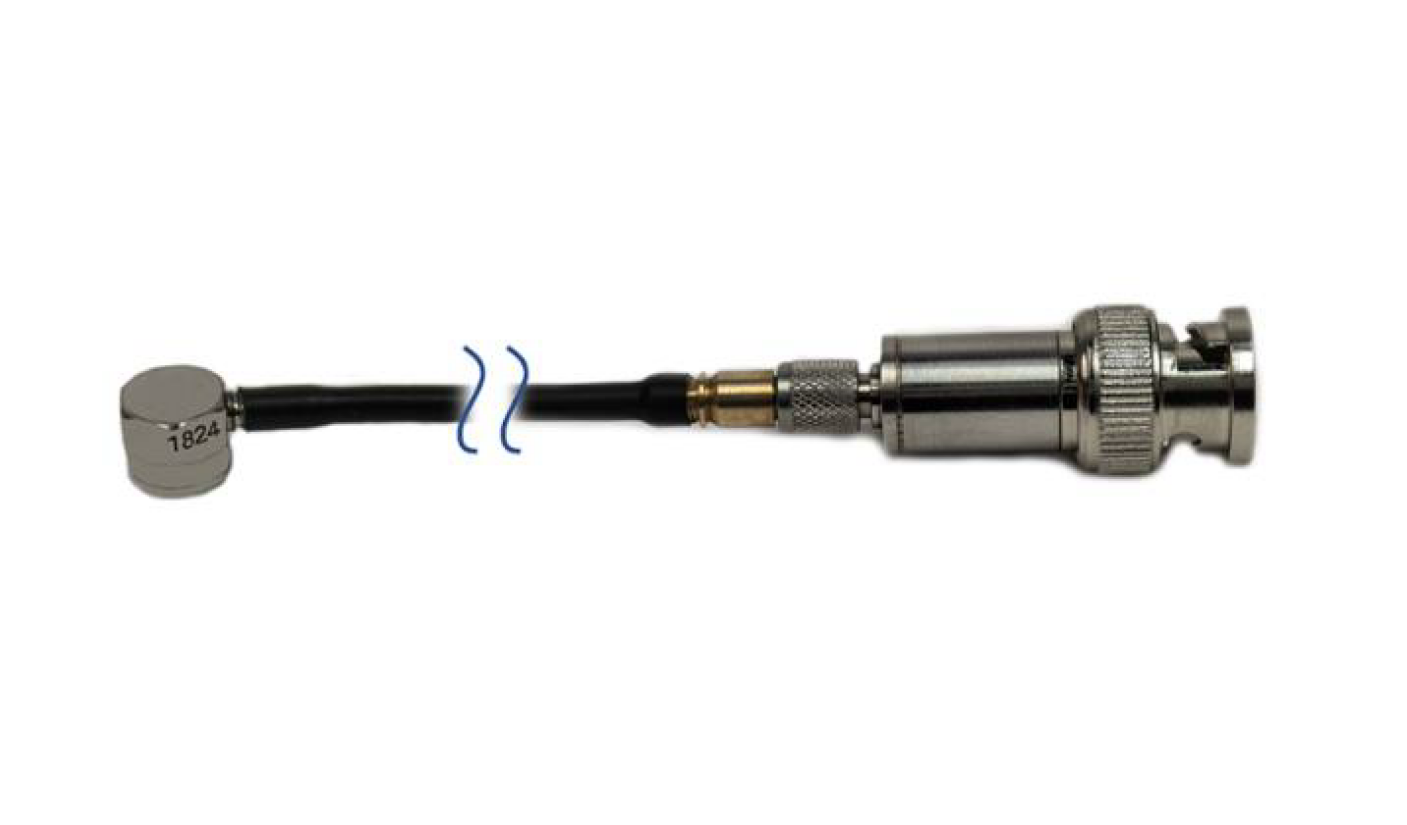
To meet the increasingly demanding testing requirements of consumer electronics and microelectromechanical systems (MEMS) production lines, MegaSig has launched the ACC 1824 miniature single-axis accelerometer . It perfectly integrates the dynamic advantages of piezoelectric materials with an ultra-miniaturized design.
The following are the core engineering values that ACC 1824 brings to production lines and R&D teams:
1. Extremely lightweight, eliminating mass load: The ACC 1824 uses a high-strength titanium alloy shell, making its total weight an astonishing 0.8 grams . This lightweight design means that when measuring tiny test objects, it has almost no additional mass impact on the structure, ensuring absolute accuracy of the vibration spectrum.
2. Shear Mode Structure: The internal piezoelectric ceramic employs an advanced “Shear Mode” design to resist environmental variations. Compared to traditional compression structures, the shear mode structure exhibits extremely low sensitivity to base bending stress and temperature. Its base strain is only 0.001 g/ με , meaning that even if the mounting surface experiences minute deformation due to vibration, no false electrical signal output will be generated, significantly improving anti-interference capabilities and test stability.
3. Exceptional Bandwidth and Dynamic Measurement Capabilities: The ACC 1824 offers a sensitivity of 10mV/g and can withstand instantaneous shocks of up to ±500g . Its mounting resonant frequency reaches >50kHz , ensuring excellent amplitude linearity (≤ 1%) and extremely low frequency error (±5% within 8kHz) across a wide bandwidth from 10Hz to 10kHz . Furthermore, its wideband resolution of 0.005 grms easily detects subtle early fault noises or minute vibrations.
4. Production Line-Friendly Integrated Design: In production line applications, cable durability and ease of connection are paramount. The ACC 1824 utilizes a single, integrated cable (3 meters long) with a standard BNC connector at the end . It uses standard IEPE power (2~10mA operating current), allowing engineers to plug and play without needing adapters or external amplifiers.
IV. Engineer’s Recommendations for Production Line Setup
If your current production line is testing products such as electric toothbrushes, e-cigarettes, smartwatches, drone motors, or electronic gimbals , traditional accelerometers will definitely fill your spectrum analysis with errors and noise.
For production line supervisors and engineers, implementing the MegaSig ACC 1824 is a highly cost-effective choice when setting up vibration or noise (NVH) testing stations for such micro motors . Its compact 0.8g titanium alloy design allows for the acquisition of the most realistic high-frequency vibration characteristics. Paired with signal acquisition cards such as the MegaSig PM 6181 or PM 6044 , which have built-in IEPE constant current sources, a modern testing system with high signal-to-noise ratio, high resolution, and perfect adaptation to factory automation environments can be built using a streamlined hardware architecture.
Need further planning consultation for your project? Feel free to contact us anytime for technical discussions.