Overview
Bone conduction/voiceprint microphones transmit the speaker’s voice to the listener by capturing vibration signals from the skull bones in the speaker’s face. Unlike traditional methods that transmit signals through the air, this effectively avoids interference from environmental noise, thereby improving speech clarity.
MegaSig Bone Conduction MEMS Microphone Test Solution – Chip Level
Taking laboratory-level testing as an example, the system consists of the following components:
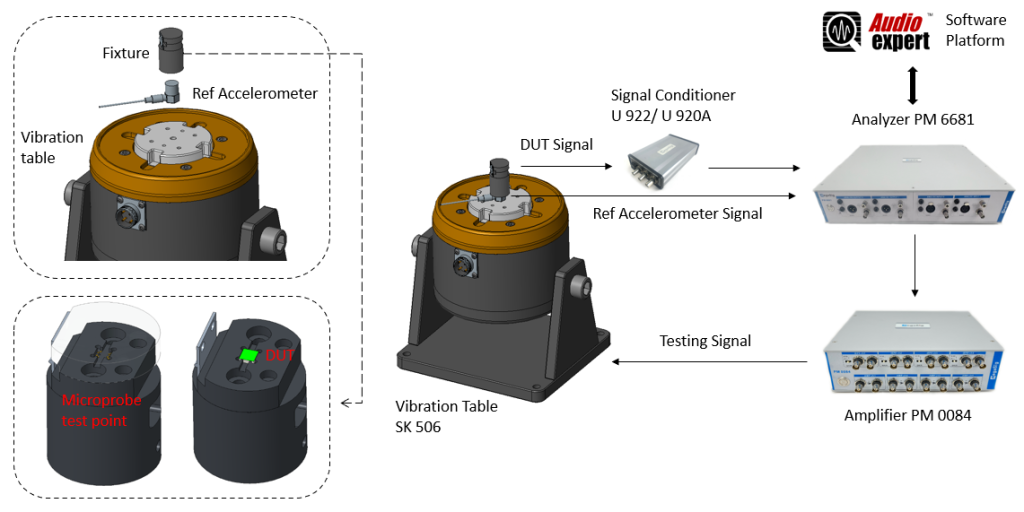
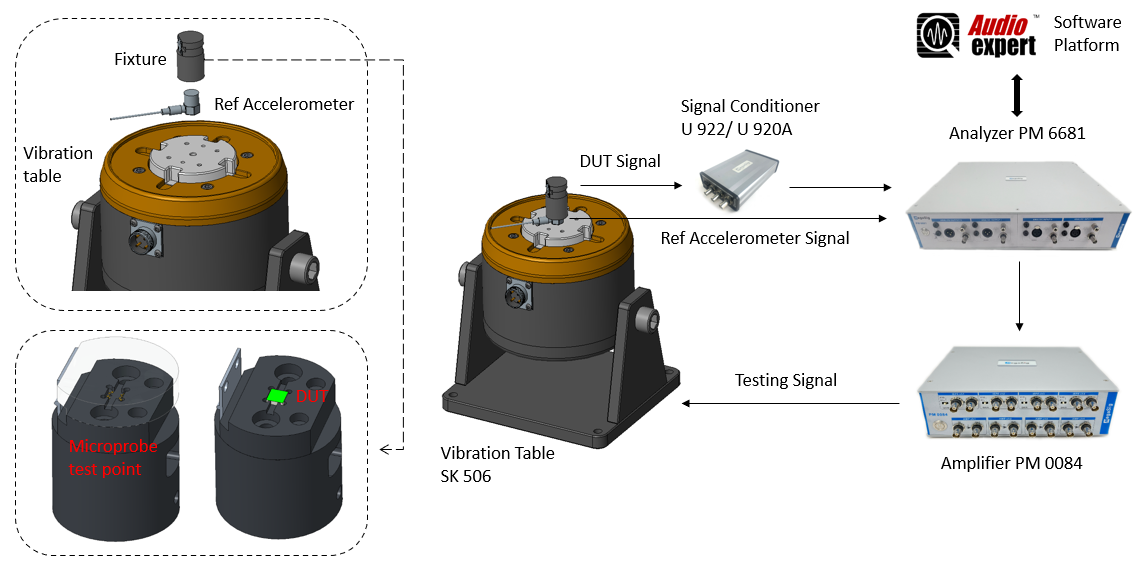
The analysis software AudioExpert sends a sweep frequency or other test signal to the vibration shaker SK 506 to make it vibrate. The test object is placed in a customized fixture and receives the vibration signal together with the reference accelerometer. Depending on whether the MEMS chip output signal is digital or analog, the signal is transmitted back to the analysis software AudioExpert for analysis after passing through the signal conditioner U 920A or U 922.
The equipment list is as follows:
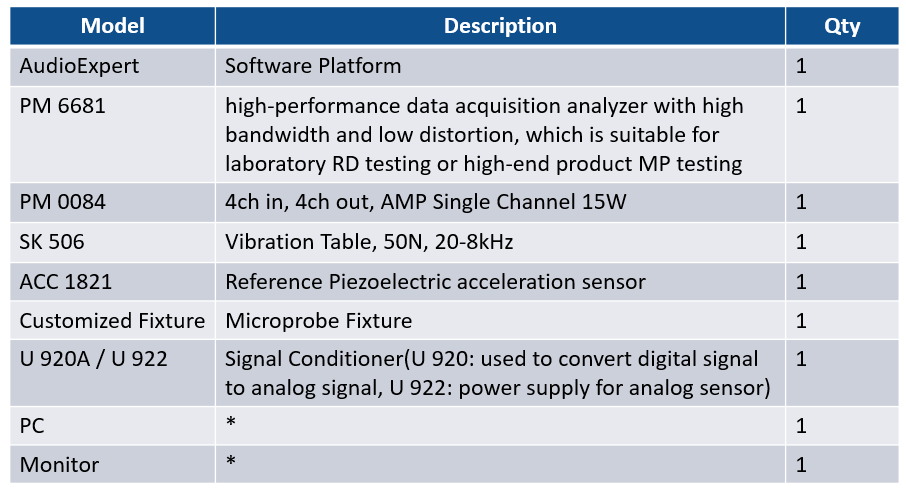
The list of items can be adjusted to suit different project requirements, such as testing accuracy, thrust force, or output power.
Semi-finished and finished product testing
Regarding semi-finished product testing, the only difference from chip level testing is the use of customized fixtures. For finished product testing, since the air conduction microphone is still present in the finished product, equipment such as a speaker, artificial mouthpiece, Bluetooth adapter, and customized silicone plug will be required.
For details, please refer to:
ENC Call Noise Reduction Test (3) – Ascending Bone Conduction Test